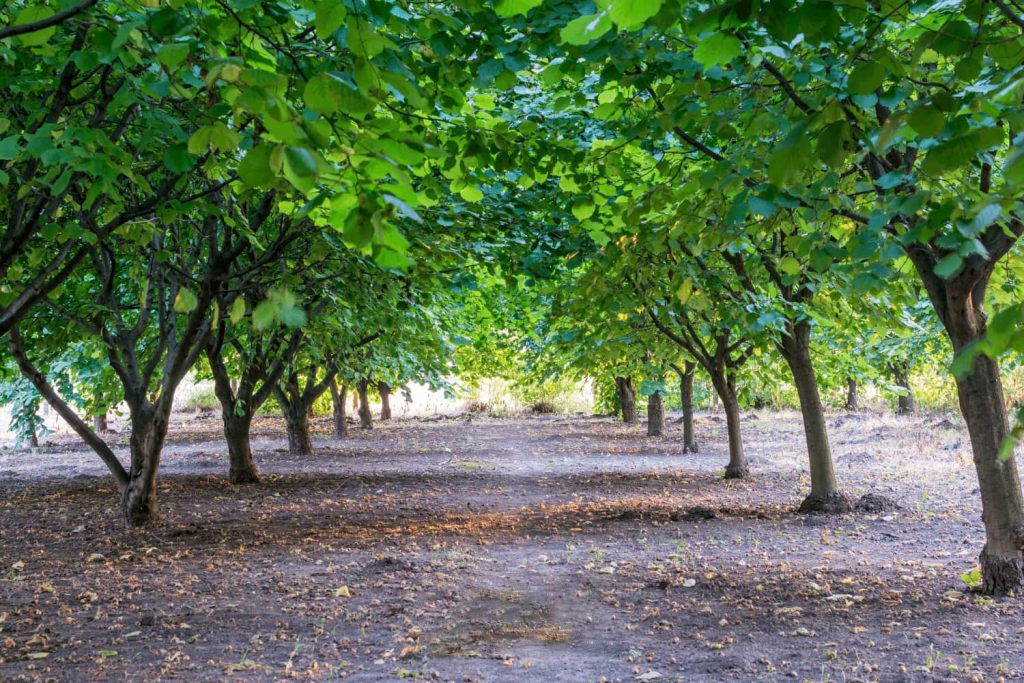
Since the hazelnut has a very long economic life, land and soil preparation must be carried out very carefully before planting. A hazelnut orchard can be established on land where annual crops have been grown, as well as on land where perennial crops have been grown, or by renewing old and aged hazelnut orchards.
On land where perennial crops have been grown, plant roots and residues are cleared. On land where annual crops have been grown, little land clearing is needed. After the general clearing of the land, soil and water conservation and drainage measures must be taken on these lands. These measures consist of preventing erosion on sloping land and draining groundwater on flat lowland.
One of the points that requires careful attention when establishing a hazelnut orchard is variety selection. With regard to the varieties included in the orchard:
Standardization should not be allowed to be compromised from the very outset by including mixed varieties in the orchard. The difficulties arising from variety mixing during hazelnut processing are also encountered in hazelnut kernel exports. For this reason, care should be taken to ensure that the pollinator varieties included in the orchard have the same nut shape and size as the main variety and are also of good quality. For a high fruit set, pollinator varieties should be included in the orchard at a ratio of 1/10. Wild hazelnut varieties that produce high-quality pollen at the beginning of female bloom, during the peak female bloom period, and toward the end of female bloom of the main variety in the orchard, and that resemble the main variety in nut shape and quality, should be planted scattered along the orchard edges on the side of the prevailing wind and within the orchard in every third row.
In high-altitude locations (500 m and above), it is more appropriate to use standard varieties that break dormancy later than other varieties and are less affected by late frosts.
TOMBUL
PALAZ
ÇAKILDAK
INCEKARA
SIVRI
KALINKARA
The hazelnut is a plant that produces root suckers. Within certain rules, it is propagated using these suckers. Root suckers suitable for this purpose should have the following characteristics:
Once root suckers with these characteristics have been selected, they should be removed with a small hoe without damaging the roots. These root suckers should be given a ”Planting Pruning” before planting. For this, wounded, bruised, and damaged roots should be cut back to the point of healthy tissue, and long roots should be shortened. The saplings should be cut with sharp shears to a length of approximately 35-40 cm, just above a bud without leaving a stub, cutting at an angle away from the bud. The saplings thus prepared should be planted without delay in the previously prepared planting holes.
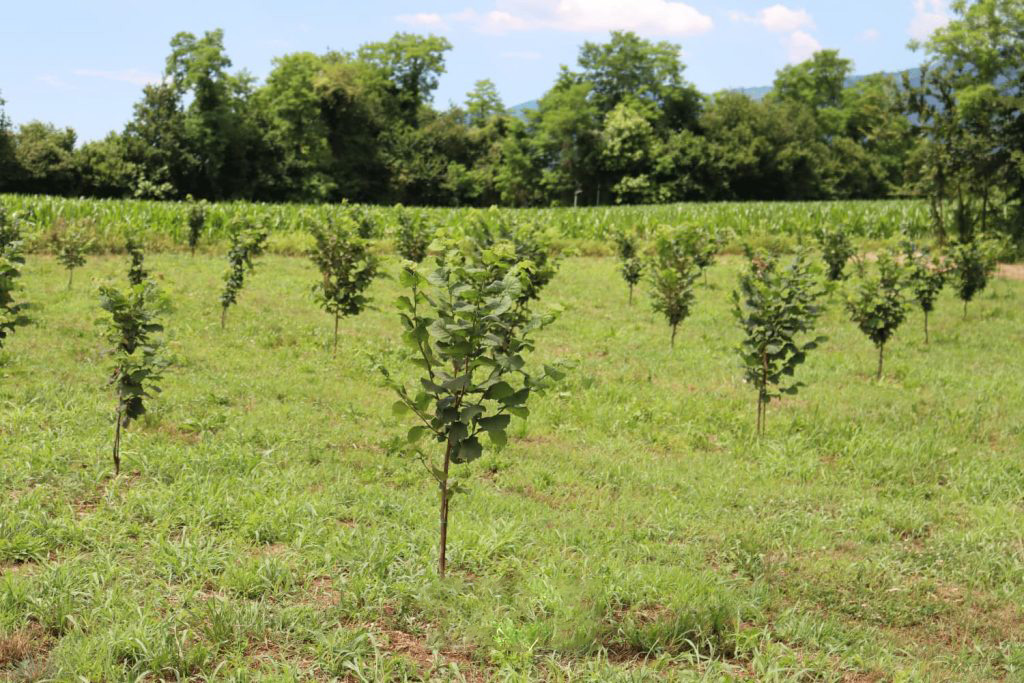
The most suitable time for planting is the autumn months. In regions with harsh winters, and where planting has been delayed, planting can also be done in spring.
Hazelnut cultivation is generally carried out according to the bush planting system. This system is the traditional planting method practiced in the hazelnut production region. In addition, another planting method, developed after many years of research at the Hazelnut Research Institute Directorate, is the hedgerow planting system. The advantages of the hedgerow planting system over the bush planting system are as follows:
The hedgerow planting system differs from the bush planting system both in planting and in form. While this planting system can be applied on flat land, it gains particular importance on sloping land and land with shallow soil. On sloping land, terracing is carried out according to the degree of slope, with a terrace top width of 1.5-2 m and a distance of 3.5-5 m between terraces. On flat land, the distance between rows should be 4-5 m. After the land has been prepared in this way, holes 50 cm wide and 30-40 cm deep are dug at intervals of 1.5-2 m; the holes to be dug in the second row are arranged so that they fall midway between two holes dug in the first row. After the farmyard manure, phosphorus and potassium fertilizers, and liming applications recommended according to the soil analysis results have been carried out, planting of the saplings begins. In planting, pollinator varieties are included among the main varieties at a ratio of 1/10, distributed evenly across the land.
One sapling is planted in the center of each hole. In the first growing year following planting, no intervention is made on the saplings. However, careful weed control must be carried out, and in particular, pests that damage the young shoots must be controlled. Each sapling should be given 40 g of 26% Calcium Ammonium Nitrate (CAN) fertilizer, half at the beginning of March and the other half at the end of May or beginning of June.
This planting method, which is more suited to flat land, should be applied on sloping land only after terracing according to the slope of the land. In the bush planting system, the planting holes should be dug at least one month before planting, 120 cm in diameter and 60 cm deep. The most important point to consider when digging the bush holes is the spacing and distance between the bushes. In setting the spacing and distance between the bushes, care must be taken to ensure that, once the bushes have reached their maximum canopy development, they do not shade one another or grow into one another. For this reason, taking the soil structure into account as well, the spacing between the centers of the bush holes should be 5-6 m on strong soils and 4.5-5 m on weak soils. After the farmyard manure, phosphorus and potassium fertilizers, and liming applications recommended according to the soil analysis results have been carried out, planting of the saplings begins. In the prepared planting holes, the saplings are placed 10 cm in from the edge of the hole at intervals of 45-50 cm, and pollinator varieties should be included among the facing saplings at a ratio of 1/10, distributed evenly across the land.
Pruning, which begins with shaping the saplings at planting, is one of the most important cultural practices in hazelnut growing, yielding positive results in ensuring annual shoot growth, increasing yield, and extending the economic life of the plant through to the end of its period of economic productivity.
Through pruning:In general, the pruning time for hazelnuts is the autumn months. Pruning of hazelnuts should begin taking into account the period when vegetative growth has stopped and most of the leaves have fallen.
The hazelnut has a very strong tendency to produce root suckers. These develop abundantly every year on the roots of the main stems. These developing root suckers share in the bush's nutrients, cause the branches to become crowded, and hinder aeration and sunlight exposure. For these reasons, throughout the production period the number of main stems planted is kept constant, and the developing root suckers should be cleared out with a small hoe at least twice a year, in autumn and at the end of May or beginning of June. However, when dried-out, broken, diseased, or aged stems are removed during the production period, one of the root suckers growing in the direction of the vacated stem is left and allowed to develop. In this way, the places of the removed stems within the bush are filled.
Fertilization is of great importance in hazelnut cultivation so that, from planting onward, the hazelnut saplings can develop healthily, form a good canopy, and, once they come into bearing, produce a high-quality crop.
Principles of Fertilization:Through its roots, the hazelnut continuously draws nutrients from the soil every year. Over time, as the nutrients in the soil become depleted, growth disorders and reductions in yield occur. The process of returning the nutrients that are deficient in the soil back to the soil is called fertilization, and the material used for this purpose is called fertilizer. Obtaining the expected benefit from fertilization is only possible by determining which nutrient is deficient in the soil and the degree of the deficiency.
Both in orchards to be newly planted and in orchards in the bearing stage, soil and leaf analyses must be carried out to determine the nutrients the hazelnut needs in order to develop normally. Many drawbacks arise when fertilizer is applied to orchards without analysis.
The hazelnut's normal development and abundant yield are made possible by the nutrients it takes up from the soil. The most important of these nutrients are nitrogen, phosphorus, potassium, and calcium. Although the other nutrients are also very important for the hazelnut, they are not as important as the aforementioned nutrients.
The growth disorders seen in the hazelnut in the case of deficiencies and excesses of the important nutrients, the fertilizers to be applied in the case of deficiency, and the application methods have been addressed as a whole.
Nitrogen Fertilizer Application Method:The amount and type of nitrogen fertilizer to be applied should be determined through leaf and soil analyses carried out in the laboratory. Recommending a specific amount and type of fertilizer without analysis will, as explained earlier, have a negative effect on the development of the hazelnut and the structure of the soil in later years.
Considering that the great majority of soils in the Black Sea region are generally acidic in character, Calcium Ammonium Nitrate fertilizer can be used safely on hazelnuts.
Taking into account the soil and climate characteristics and the periods when nitrogen is most needed for the normal development of the hazelnut, it is generally appropriate to apply nitrogen fertilizer twice a year. In the first application, depending on the climatic conditions of that year, half of the recommended nitrogen fertilizer should be applied in the period before the hazelnuts break dormancy, i.e., at the end of February or beginning of March. The other half of the recommended fertilizer should be applied as the second application during the period of flower bud formation, i.e., at the end of May or beginning of June.
Nitrogen fertilizer is spread evenly in a ring-shaped band 30-40 cm wide beneath the drip line of the bush branches and mixed into the soil with a hoe to a depth of 5-10 cm. If the area beneath the bushes is weedy, the area to be fertilized should first be cleared of weeds with a hoe. Although the method of applying nitrogen fertilizers is generally the same for all orchards, it shows some differences depending on whether the orchard is flat or sloping. While on flat land the hazelnut roots are distributed equally in all directions beneath the drip line of the branches, on sloping land the hazelnut roots develop most on the sides of the bushes, partially on the lower side, and least on the upper side. For this reason, nitrogen fertilizers should be applied in a ring-shaped band formed taking into account the distribution and development of the hazelnut roots.
Phosphorus Fertilizer Application Method:Since phosphorus fertilizers generally remain effective in the soil for a long time, they are used once every 3 years, in the period between November and February, in the amounts recommended according to the leaf and soil analysis results.
Phosphorus fertilizers are applied by distributing them equally into 16-32 holes, 15-20 cm deep, dug beneath the drip line of the bush branches according to the size of the bush, and then covering them with soil. With this method of application, the fertilizer's contact surface with the soil is reduced, it is prevented from becoming unavailable, and its uptake by the plant is facilitated.
Potassium Fertilizer Application Method:The hazelnut soils of the Black Sea region are generally sufficient in potassium. If fertilization is carried out on soils found to be sufficient in potassium, not only will this fertilization be of no benefit whatsoever, it will also contribute to the further acidification of acidic soils. Application should be made only to orchards found to need it according to the analysis results.
Potassium, like phosphorus, is a nutrient that is retained in the soil. Its retention in the soil is affected by factors such as soil acidity, the amount of organic matter, and a high cation exchange capacity. For this reason, potassium fertilizers should be applied in the period between November and February, as described in the phosphorus application method. Potassium fertilizer should likewise be applied once every three years.
Other Nutrients and Application Methods:The nutrients the hazelnut needs for its development are not only nitrogen, phosphorus, and potassium; they also include nutrients such as Ca, Mg, Fe, Mn, Zn, Cu, and B, which are just as important in terms of their general functions and the processes they perform. In recent years, deficiencies of these nutrients have begun to appear here and there in hazelnuts in the form of yellowing and deformation of the leaves, nut drop, and an increase in the formation of blank nuts. Applying those elements found to be deficient according to the leaf analyses carried out will have a positive effect on the development and yield of the hazelnut. These nutrients are applied to fruit trees by two methods: foliar application and soil application.
Foliar fertilizer application is more advantageous than soil application, both because less fertilizer is used and because the symptoms caused by the deficiency are remedied in a short time. The concentrations that must be used for each nutrient are known. Using more than these amounts is harmful, as it will cause scorching of the leaves and nuts, so great care must be taken. Foliar applications are carried out with sprayers. In foliar application, the upper and lower surfaces of the hazelnut leaves should be completely wetted with the fertilizer solution, and spraying should continue until no dry spot remains on any of the green parts of the bush. Depending on the size of the bush, 3-4 liters of solution is sufficient to wet the entire bush. On the day of application, the weather should not be too hot (around 20C); it is best to apply early in the morning or toward evening. In addition, for the nutrient to be absorbed through the leaves, there should be no rain for at least 1-2 days. If it rains immediately after application, the application should be repeated. These nutrients are applied after the hazelnut leaves have completed their normal development, from May through July, 2-3 times at intervals of 15-20 days depending on the severity of the deficiency. Soil application should be carried out in the same way as the application of phosphorus fertilizers.
Liming in Hazelnut Orchards in the Bearing Stage:The hazelnut plant achieves its normal development and produces abundant crops on soils with a pH between 5 and 7. However, the soils of the Black Sea Region where hazelnut farming is practiced are generally acidic in character. The acidic character of the soil not only hinders the uptake of certain elements such as nitrogen, phosphorus, and potassium, but also increases the solubility of elements such as iron and aluminum, causing them to have a toxic effect. The damage that lime deficiency in the soil will cause to the hazelnut is directly related to the inability to take up other nutrients and to the characteristics of the soil structure, and takes the form of premature yellowing of the leaves, dieback of the terminal shoots, weak root formation, and the appearance of the symptoms seen in nitrogen, phosphorus, and potassium deficiency.
Liming acidic soils improves the physical, chemical, and biological properties of the soil. The aeration, warming, and water-holding properties of the soil are also improved. Microorganism activity in the soil increases; liming promotes the decomposition of some nutrients and prevents others from being leached away by retaining them in the soil. In particular, it raises the acidic soil to the normal pH level that the hazelnut requires for its development.
Whether hazelnut orchards need lime, and how much lime should be applied, is determined according to the results of soil analyses. Liming orchards where the soil acidity (pH) is already suitable will not only disrupt the soil structure but also cause the hazelnut to be harmed by excess lime. The physical structure of the soil is a factor in the amount of lime to be applied; the amount to be applied to light-textured soils is less than that for heavy-textured soils. In addition, the type of lime to be used has a major effect on the timing of application. For hazelnuts, the months of November-December are generally suitable for liming. The liming process should be repeated every 4-5 years, if needed, after having a soil analysis carried out.
Liming is applied in hazelnut orchards by two methods. The recommended amount of lime is spread uniformly and evenly over the entire orchard and hoed in as deeply as possible without damaging the roots. Alternatively, it is distributed uniformly in a ring-shaped band 50-60 cm wide beneath the drip line of the bush branches and hoed in as deeply as possible. In this case, the amount of lime to be applied is less than with the first method.
Application of Farmyard Manure in Hazelnut Orchards in the Bearing Stage:Farmyard manure and similar organic fertilizers applied to the soil have positive effects on increasing soil fertility, retaining nutrients in the soil, raising the water-holding capacity and cation exchange capacity, soil aeration and workability, the soil reaching a workable moisture condition earlier, and aggregate formation.
Farmyard manure consists of the liquid and solid excreta of animals together with the material used as bedding. The composition of farmyard manure varies depending on the age, species, and nutritional status of the animal and the type of material used as bedding. 1 ton of barn manure contains on average 5.5 kg of nitrogen, 2.5 kg of phosphorus, 5.5-6 kg of potassium, and other important nutrients.
For farmyard manure to acquire its properties, and thus to have a positive effect on the soil and the hazelnut plant, it must have fermented for 6 months to 1 year. For fermentation, the farmyard manure is placed in the manure pit in a layer 80 cm thick, without being compacted. When the temperature of the manure rises to 55-60 C, it is moistened, a certain amount of phosphorus fertilizer and a certain amount of lime are added and mixed in, it is compacted, and it is covered with soil so that it is airtight. Fertilization should be carried out with farmyard manure that has fermented in this way.
In hazelnut orchards, these manures are distributed evenly, about 30-40 kg per bush, in a ring-shaped band 50-60 cm wide beneath the drip line of the bush in autumn or early spring, and immediately hoed into the soil. If the manure is left beneath the bushes without being hoed in, it loses a great deal of its value. Because the Black Sea Region receives heavy rainfall, fermented farmyard manure should be applied in spring before the hazelnuts break dormancy. If applied in autumn, the value of the manure in regions receiving heavy rainfall decreases significantly, even by half. Barn manure should be applied once every 3-4 years, depending on the general structure of the soil and its organic matter content.
In cases where farmyard manure is not available, another method of adding organic matter to the soil is green manuring. Green manure plants for hazelnut orchards are plants such as vetch, wild pea, and oats; these are sown in autumn in a ring-shaped band 50-100 cm wide beneath the drip line of the branches on sloping land, and over the entire orchard on flat land, and in spring they are mowed before flowering and mixed into the soil. This practice should be continued for several consecutive years in places where the soil is low in organic matter. In addition, compost obtained from materials such as leaves, corn stalks, and the like in the orchards can also be used to increase soil fertility. The decomposition of these residues, i.e., their conversion into a usable form, requires certain procedures, as with farmyard manure. Once the compost has been obtained, it should be scattered beneath the drip line of the hazelnut branches and mixed into the soil to a depth of 5-10 cm.
| FERTILIZERS | APPLICATION TIME | APPLICATION METHOD |
| NITROGEN | Half of the recommended amount should be applied in MARCH and the remainder at the end of MAY | Spread in a band 30-40 cm wide beneath the branch tips and mixed into the soil to a depth of 5-10 cm. |
| PHOSPHORUS | Applied once every 3 years in the period between NOVEMBER and FEBRUARY. | Placed in equal amounts into 16-32 holes 15-25 cm deep beneath the branch tips and covered with soil. |
| POTASSIUM | Applied once every 2-3 years in the period between NOVEMBER and FEBRUARY. | Placed in equal amounts into 16-32 holes 15-25 cm deep beneath the branch tips and covered with soil. Can be applied together with phosphorus fertilizer. |
| LIME | Applied once every 3-5 years in the period between NOVEMBER and DECEMBER. | Spread uniformly in a ring-shaped band 40-50 cm wide beneath the branch tips and hoed into the soil to a depth of 5-10 cm. |
| BARN MANURE | Applied once every 3-4 years in the period between NOVEMBER and MARCH. | Scattered in a band 50 cm wide beneath the bush branches and mixed into the soil to a depth of 5-10 cm. |
| MICRONUTRIENTS | Mg, Fe, B, etc. Foliar: Applied 2-3 times at intervals of 15-20 days between MAY and JULY. SOIL: Applied once before leafing out |
Carried out by spraying low-concentration solutions (0.1-1%) until no dry spot remains on the leaves. Distributed uniformly in a ring-shaped band 30 cm wide and 10 cm deep beneath the branch tips and covered with soil. |
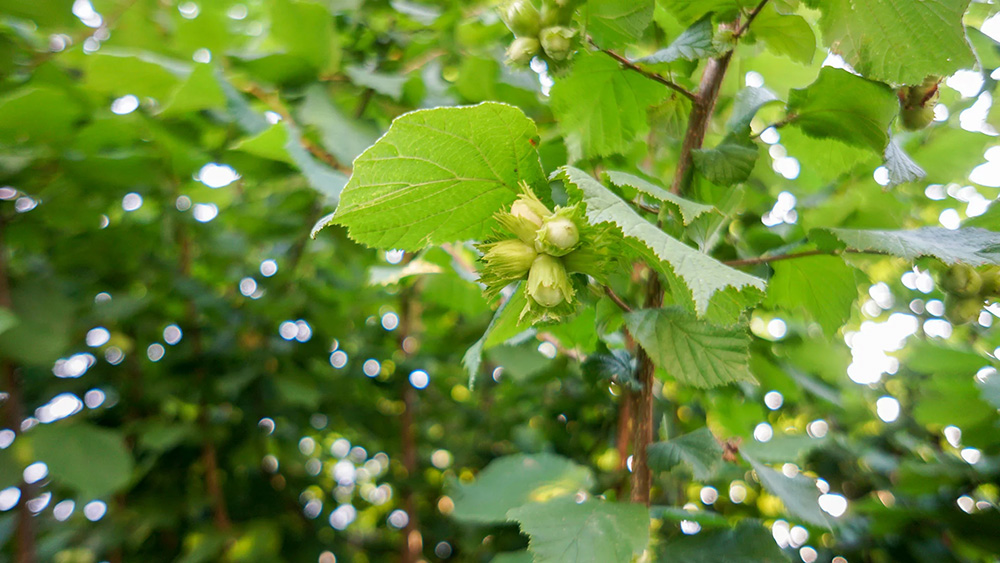
Harvest: Before starting the harvest, a general clean-up should be carried out in the hazelnut orchards. The rainy climate of the region and the resulting abundant and rapid growth of weeds and thorns not only make the hazelnut harvest more difficult but also cause nuts that fall to the ground to be lost. For this reason, at least 5-10 days before harvest, the orchard must be thoroughly cleared with the tool known as a girinti.
Not all hazelnut varieties reach harvest maturity at the same time. Some varieties ripen early, others later. Although it is most appropriate to harvest the varieties separately, each when it reaches harvest maturity, the fact that hazelnut orchards are made up of mixed varieties makes it necessary to carry out the harvest when the predominant hazelnut variety in the orchard has ripened.
Whether the hazelnuts have reached harvest maturity can be determined by looking at certain characteristics.
These characteristics are as follows:
Many drawbacks arise in hazelnuts harvested before reaching harvest maturity.
These drawbacks are:
Although the harvest time of the varieties grown in the Black Sea hazelnut region varies from year to year, it is August 1-10 in the coastal zone, August 10-20 in the middle zone, and after August 20 in the upper zone.
Although the best way to harvest hazelnuts is to shake them down and collect them from the ground, there are very few orchards in the region that allow for this type of harvest. With this method of harvesting, since the nuts are collected at full harvest maturity, the yield and quality are good, and the branches, twigs, and the buds that will form next year's crop are not damaged.
The harvesting method most commonly practiced in the region is hand-picking from the branch. The most important points to observe with this method of harvesting are that the branches should not rub against one another, the nut clusters should be plucked one by one from the point where they join the branch, picking should not be done by stripping so as not to knock off the branches, twigs, and buds that will form next year's crop, and the harvested branch should be carefully returned to its position. In addition, the hazelnut varieties in the orchard should be harvested separately without being mixed together.
Baskets of 5-7 kg tied around the waist are used in the harvest. One person can pick an average of 75-100 kg of hazelnuts in the husk per day. From these harvested in-husk hazelnuts, dry hazelnuts ready for milling are obtained at a ratio of approximately 1/3.
Threshing: The hazelnuts collected in baskets are carried to the threshing areas on the back or by vehicle, in 30-40 kg baskets known, depending on the locality, as harar, selek, or hey, or by filling them into sacks. In the region, threshing areas are generally flat or gently sloping meadows and places with hard-packed soil. Considering the climatic conditions of the region, the most suitable option is for threshing areas to be made of concrete with a slight slope.
Hazelnuts brought to the threshing area should not be left in piles. They are immediately spread out with a rake over the threshing area in a layer 10-15 cm thick. In sunny weather, they are dried for 3-5 days, being turned every day with a wooden shovel or rake. Once these hazelnuts have dried to a certain extent, they are separated from their husks by feeding them into the hazelnut dehusking machine known as a patoz. The dehusked hazelnuts are spread out in a layer 2-4 cm thick, on cloth in earthen threshing areas and without cloth in concrete threshing areas. In sunny weather, they are turned with a rake 2-3 times a day to ensure that they dry. After drying in this way for 3-4 days, the hazelnuts are passed through a winnowing fan to separate them from dust, soil, husk fragments, and blanks. The hazelnuts cleaned in this way are spread out again on the threshing area, and hard foreign objects such as stones and soil are removed from among them. Broken and worm-holed hazelnuts and any other mixed-in kernels are picked out; the nuts are then filled into sacks, the mouths of which are sewn shut, and prepared to be taken to market.
The threshing process generally begins on August 15 and continues until the end of September. During threshing, care must be taken to ensure that the hazelnuts dry thoroughly and that the moisture content does not exceed 12% for in-shell hazelnuts and 6% for hazelnut kernels.
Storage: The storage of hazelnuts that have been dried after harvest to bring their moisture content into line with storage requirements is important.
In storage, which is particularly important for exporting individuals and organizations, attention must be paid to certain points. The place to be used as a warehouse should be cool, dry, and well-ventilated. Under these conditions, hazelnuts can be stored for a maximum of 1 year without deterioration of their properties. For storage longer than 1 year, the temperature must be 2-4.5 C and the relative humidity between 55-60%. A rise in temperature leads to rancidity, and an increase in relative humidity leads to mold.
Hazelnuts that have been harvested before harvest maturity, not dried properly, and are too moist are quite difficult to store, and such hazelnuts develop mold, rancidity, and heating. The oils present in hazelnuts at a rate of 55-70% undergo changes during storage, forming free fatty acids such as oleic acid (75-80%), palmitic acid (15-20%), and small amounts of stearic acid, which make the hazelnut rancid. Likewise, fungal species of the genera Aspergillus and Penicillium, which produce aflatoxin that is harmful to human and animal health, are a significant concern in hazelnuts, and it is believed that they result from early harvesting, improper threshing, and unsuitable storage conditions.